


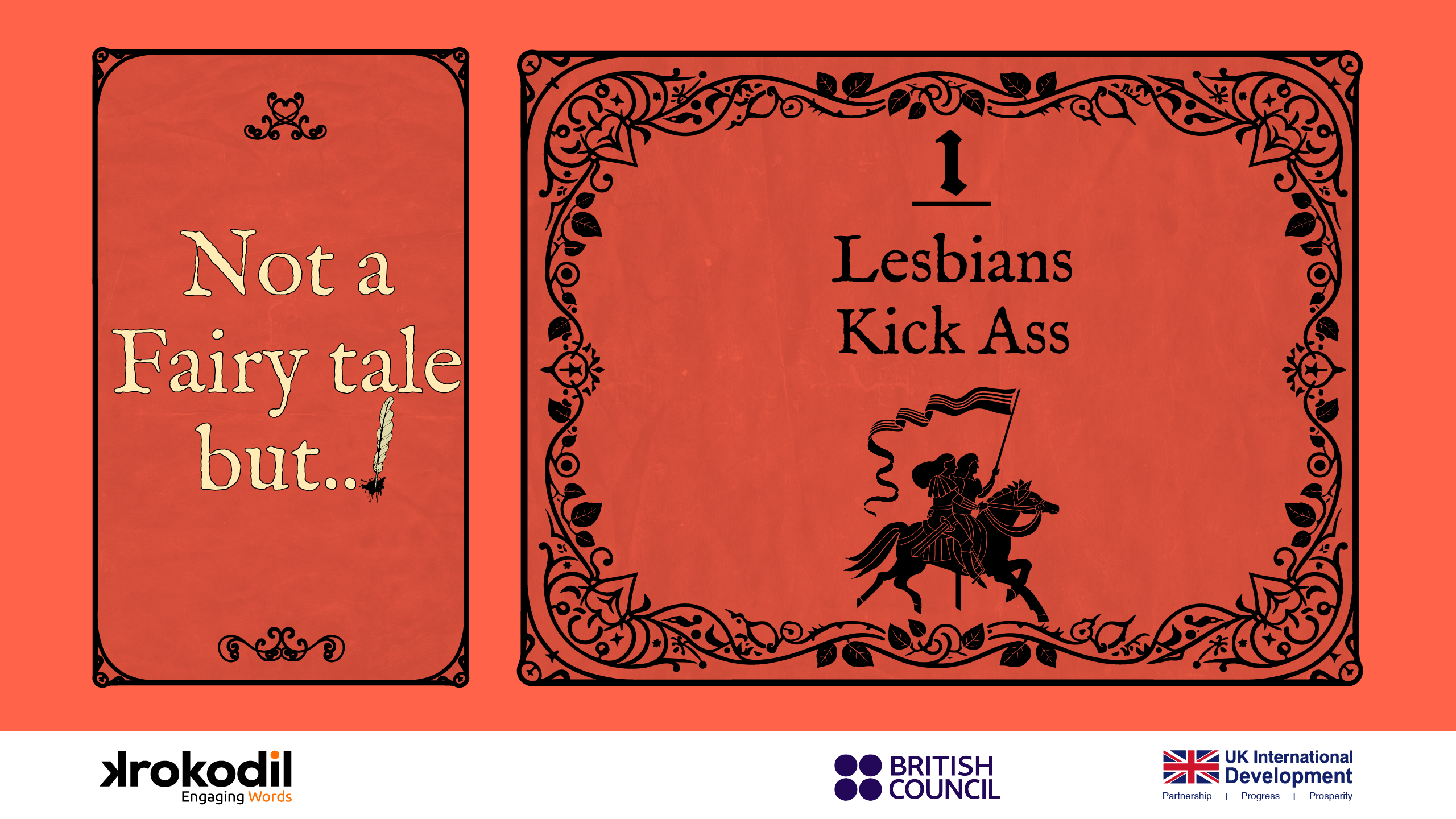
05 Feb Not a Fairy Tale But…
On Thursday, February 19th at 6:00 PM at the Museum of the 90s (Kneza Miloša 3, Belgrade), we are launching a series of regional events, dialogues, talks, exhibitions, and multimedia campaigns through which, in five monthly chapters, we tell the story of “Not a fairy tale but…”
The conversation will feature the authors and collaborators of the first chapter, titled “Not a fairy tale but… Lesbians Kick Ass”: Dragoslava Barzut, Nađa Bobičić, and Dejana Cvetković, while the discussion will be moderated by the chapter editor Milena Berić. Attendees will also have the opportunity to tour a conceptual presentation of Lepa Mlađenović’s manifesto The Politics of Women’s Solidarity in the form of a spatial installation.
At a time when nationalism was fanning the flames of war in the Balkans, women united in resistance, building bridges of solidarity and showing that humanity is stronger than hatred. During the breakup of Yugoslavia in the 1990s, feminists from the region united against nationalism, war, and patriarchal society, organizing artistic interventions, travels, correspondence, and protests. As an act of resistance, they visited one another even during the armed conflicts.
Peace activists from Serbia and Kosovo were frequently targeted by nationalists, media demonization, and violence. They did not have projects or their own offices; rarely did any of them have their own apartment. Agreements were mostly made in kafanas (taverns). Tensions were rising in Kosovo; women wanted to stop this war. The feminist movement spilled over into the anti-war movement of the ’90s. Women wrote about the extent of the nationalism and hatred between Serbs and Albanians—which were being forced, and which were connected to the patriarchy and patriarchal mythology related to the traditional family, wars, and heroes.
Feminists in these territories were networked throughout the wars. They constantly insisted that the war was being waged in our name and that nationalism inevitably leads to the deterioration of women’s status. Activists, feminists, and mothers of soldiers gathered around Women in Black stood dressed in black for one hour every Wednesday at Republic Square, protesting against the wars in the territory of the then-Yugoslavia. There were ups and downs in communication between women from Serbia and Kosovo. The political situation affected their relationships and the confrontation of arguments. There were many tears and emotional moments, but despite everything, friendships survived even thirty years later.
Today, with the rise of nationalism and ethnic tensions, their struggle for peace, justice, and solidarity remains as a legacy for new generations, who have the task of breaking transgenerational traumas and building mutual trust. It is precisely this legacy we will discuss at the Museum of the 90s on Thursday, February 19th, starting at 6:00 PM. Admission is free and the dialogue is open.
See you there.
About “Not a Fairy Tale But…”
Through five monthly chapters, in various formats—audio, video, text—we bring true stories about the real heroines of the nineties: activists, peacemakers, feminists, and fighters who opposed war, nationalism, and political repression during the breakup of Yugoslavia. These are women who refused to be enemies to one another, regardless of which side they found themselves on, because they understood that sisterhood knows no nation and that love and care for others are the only cure for hatred.
Our intention is to map and analyze the legacy of the women’s peace movement of the nineties, in which the struggle was not fought with a rifle in hand but on the streets, in cultural institutions, on SOS hotlines, and in shelters. Peace activism was a sure path to being accused of “betraying the nation,” but also the direct successor to the women’s anti-fascist struggle.
The focus is on stories of resistance and persecution: from Mira Furlan and the “Witches of Rio” to Vesna Teršelič and Nataša Kandić; from the murdered Suada Dilberović and Olga Sučić to the brave actions of Borka Pavičević, CZKD (Center for Cultural Decontamination), the Center for Anti-War Action, Women in Black, the Spiritual Republic of Zicer, Biljana Jovanović, Lepa Mlađenović, Igballa Rogova, and other important protagonists whose biographies represent the nodal points of this important legacy.
Through storytelling, we explore how today’s young activists and students adopt and reshape these practices in the fight against contemporary political repression: which tactics, symbols, and ethics of resistance they choose; how they connect a feminist approach to peace with labor, social, and other civil rights; and how they preserve memory and insist on justice today in Belgrade, Zagreb, and Sarajevo.
“Not a fairy tale but…” hereby opens its chapters.
This project is funded by the UK International Development Programme and is implemented in partnership with the British Council.
Sorry, the comment form is closed at this time.