


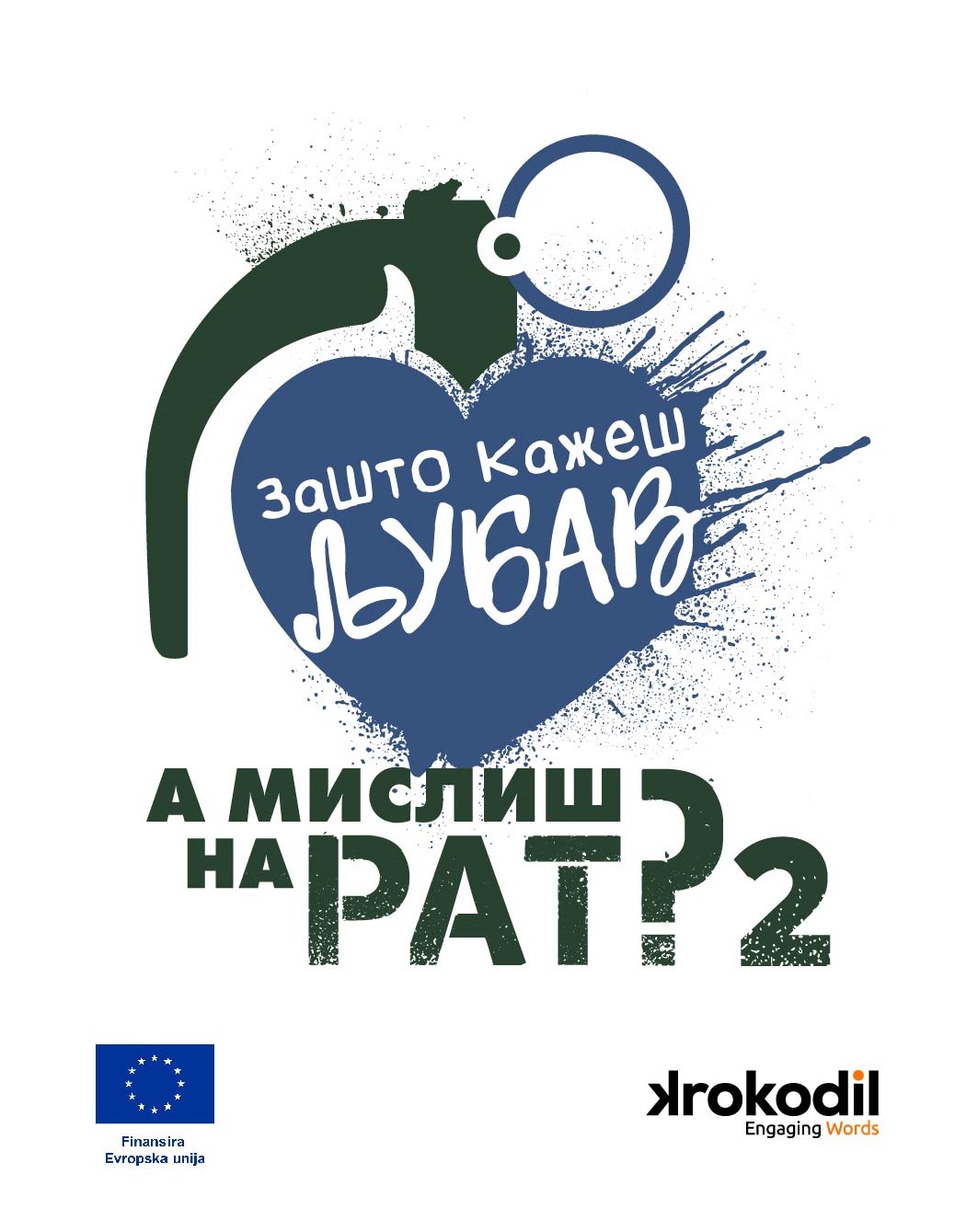
12 Feb Why Do You Say Love When You Mean War? 2.0 Results of the Second Research and Analysis of Undue Influence on the Increase of Violence in Serbian SocietyWhy Do You Say Love When You Mean War? 2.0
During the second half of 2025, a team of researchers and associates of the KROKODIL Association began collecting data and preparing research – Why Do You Say Love When You Mean War? 2.0 – research, analytical, and public work initiated in 2023, with the aim to engage the community, advocating, educating, and raising awareness about the dangers of undue influences contributing to the increase of violence in our society. The program grew up to be one of the most important KROKODIL’s programs.
The new, second edition of the research Why Do You Say Love When You Mean War 2.0 will be officially presented on Tuesday, February 24th, at 6 PM, at the National Theatre in Sombor. Speakers at the event are the research authors: researcher and political scientist Srđan Hercigonja and researcher and communicologist Milena Berić, as well as the authors of essays who broadened and added to the quality of it: psychologist and professor, Ana Mirković, child and adolescent psychiatrist Dr. Roberto Grujičić, researcher and anthropologist Lara Končar, and history professor Dubravka Stojanović.
This new research was conducted in the context of the greatest political and social crisis in Serbia since the democratic changes of 2000. For fourteen months, Serbia has been rocked by major protests, marked primarily by a student and even a civic uprising, which arose in reaction to the tragedy in Novi Sad, when the collapse of a canopy at the railway station on November 1, 2024 killed 16 people. A large part of the public perceived this disaster as the result of the pervasive corruption that extends to the highest echelons of the authorities and the ruling regime. It initiated months-long protests, to which the authorities responded primarily with violence and repression against students, educators, civil society organisations and independent media. It was in this atmosphere of a “de facto state of emergency” that this research was conducted, together with writing the analysis.
It can immediately be concluded that the participants in that earlier study perceived violence in Serbian society more as a diffuse, uncontrolled phenomenon, and that they did not have a clear understanding of how to resist it. The conclusion will show that in Serbian society there is a direct and invisible influence from the state and the media in maintaining a specific and widespread ‘culture of violence’. The narratives of aggressive discourse, the glorification of crime, and the absence of a systemic strategy to curb violence contribute to the increase of various forms of violence, including femicide. Induced violence has become a painful everyday reality for the citizens of Serbia, and violence has remained the ultima ratio of political practices. Young people show a significant lack of knowledge about these events and find themselves in a limbo between an ethno-national and a cosmopolitan identity, making them an easy target for instrumentalisation. Three decades after the war, convicted war criminals are returning to Serbia with the open respect of certain state officials and positive attention from pro-regime media, contributing to the perpetuation of distorted attitudes about the legacy of the nineties. Stencils, graffiti and murals, as relatively new forms of aesthetic-ideological pollution of urban space, are used to promote reactionary and hateful policies, glorify convicted war criminals and incite violence. Due to the years of instrumentalisation of young people, this paper has once again focused specifically on urban forms of propaganda, though we have not neglected other channels in our analysis, such as traditional media, a strictly controlled education system, and captured institutions.
We invite all interested citizens, representatives of cultural institutions, academia, civil society, media, and student initiatives to join us.
Admission is free.
The Report and public event are implemented with the financial support of the European Union. The views expressed in the Report, as well as at this public event, are the sole responsibility of the authors/KROKODIL Association and do not necessarily reflect the views of the European Union.
Sorry, the comment form is closed at this time.