


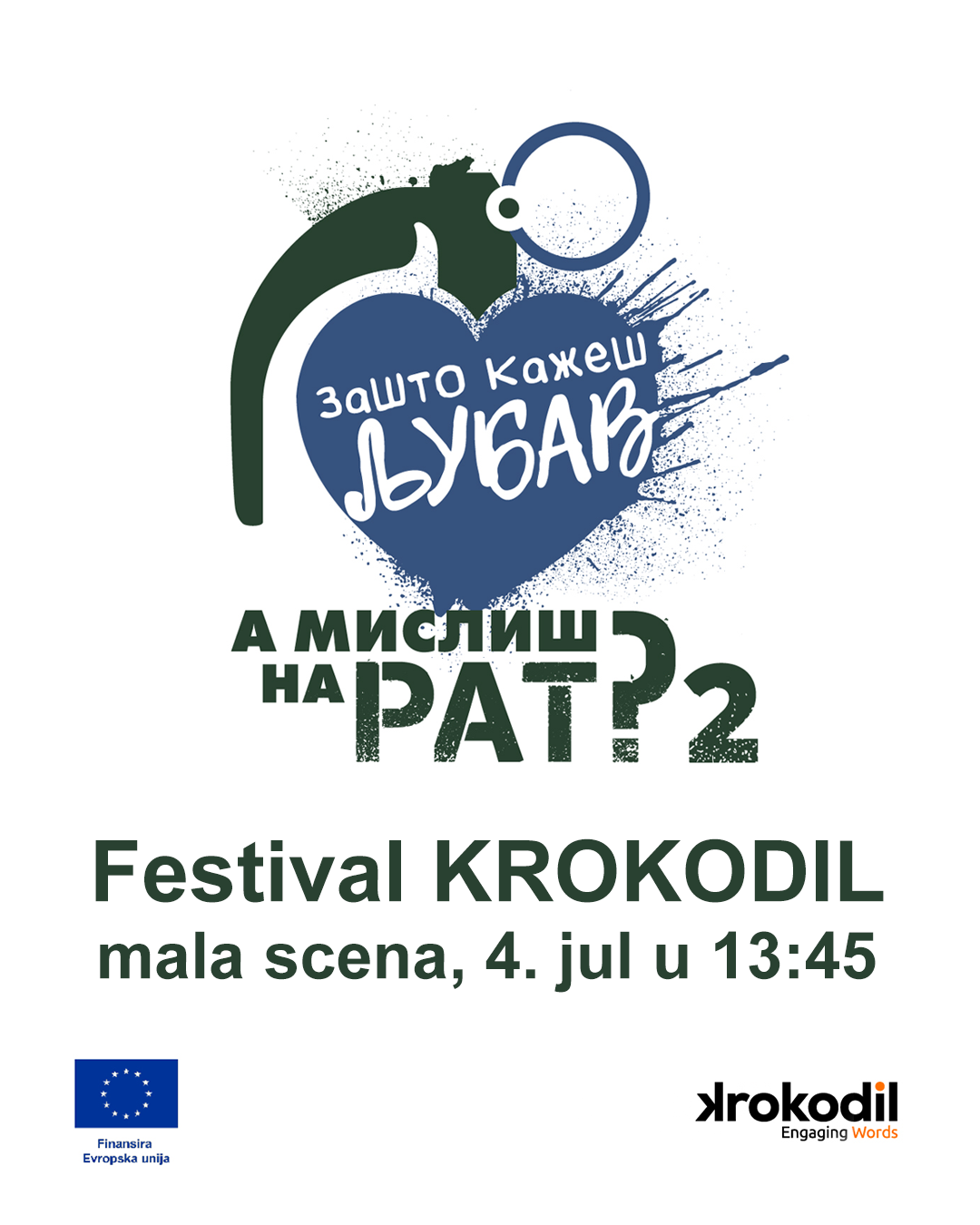
18 Jun WHY DO YOU SAY LOVE WHEN YOU MEAN WAR? 2.0 AT THE KROKODIL FESTIVAL
Why Do You Say When You Mean War? 2.0
Presentation of the research at the KROKODIL Festival
Saturday, July 4, 2026
13:45–14:45
Studio Stage, park in front of the Museum of Yugoslavia
Free admission!
We invite all interested citizens, cultural workers, students, and especially young people, to join us for a conversation about the second edition of the research Why Do You Say Love When You Mean War? 2.0, on undue influences behind the rise of violence in Serbia, and on the connection between violence and the lack of confrontation with collective traumas resulting from the wars of the 1990s, which will be officially presented as part of the 18th KROKODIL Festival. We close the second cycle of the research with the ceremonial presentation of the new, second edition of the publication Why Do You Say Love When You Mean War? 2.0 on Saturday, July 4, 2026 at the Small Stage of the Festival.
The research results, part of one of the key research and public programs of the KROKODIL Association, launched in 2023 with the aim of understanding and mapping undue influences on the rise of violence in society, will be presented in conversation by the co-authors of the research, Milena Berić and Srđan Hercigonja, with guests Snježana Milivojević, Olga Kavran, and Lara Končar.
The new research, conducted during 2025 and 2026, examines ways in which contemporary forms of violence can be understood in a broader historical, cultural, and political context, particularly in relation to the legacy of the 1990s wars. Through an interdisciplinary approach and conversations with actors from science, culture, media, and civil society, the research analyzes how collective memories, public discourse, the education system, and symbolic content in public space influence the perception of violence—especially among young people. The findings point to a shift in citizens’ perceptions: violence is increasingly seen less as an isolated phenomenon and more as a systemic and politically produced mechanism, supported through the media, public speech, and institutional practices. Special focus is placed on young people, who find themselves between opposing identity narratives and are particularly exposed to manipulation and processes of radicalization.
We invite you to join the conversation about how patterns of violence arise and are sustained, and where opportunities for resistance and change open up.
This public event is realized with financial support from the European Union. The views expressed in the research and at the event are the sole responsibility of the authors and do not necessarily reflect the views of the European Union.
Sorry, the comment form is closed at this time.