


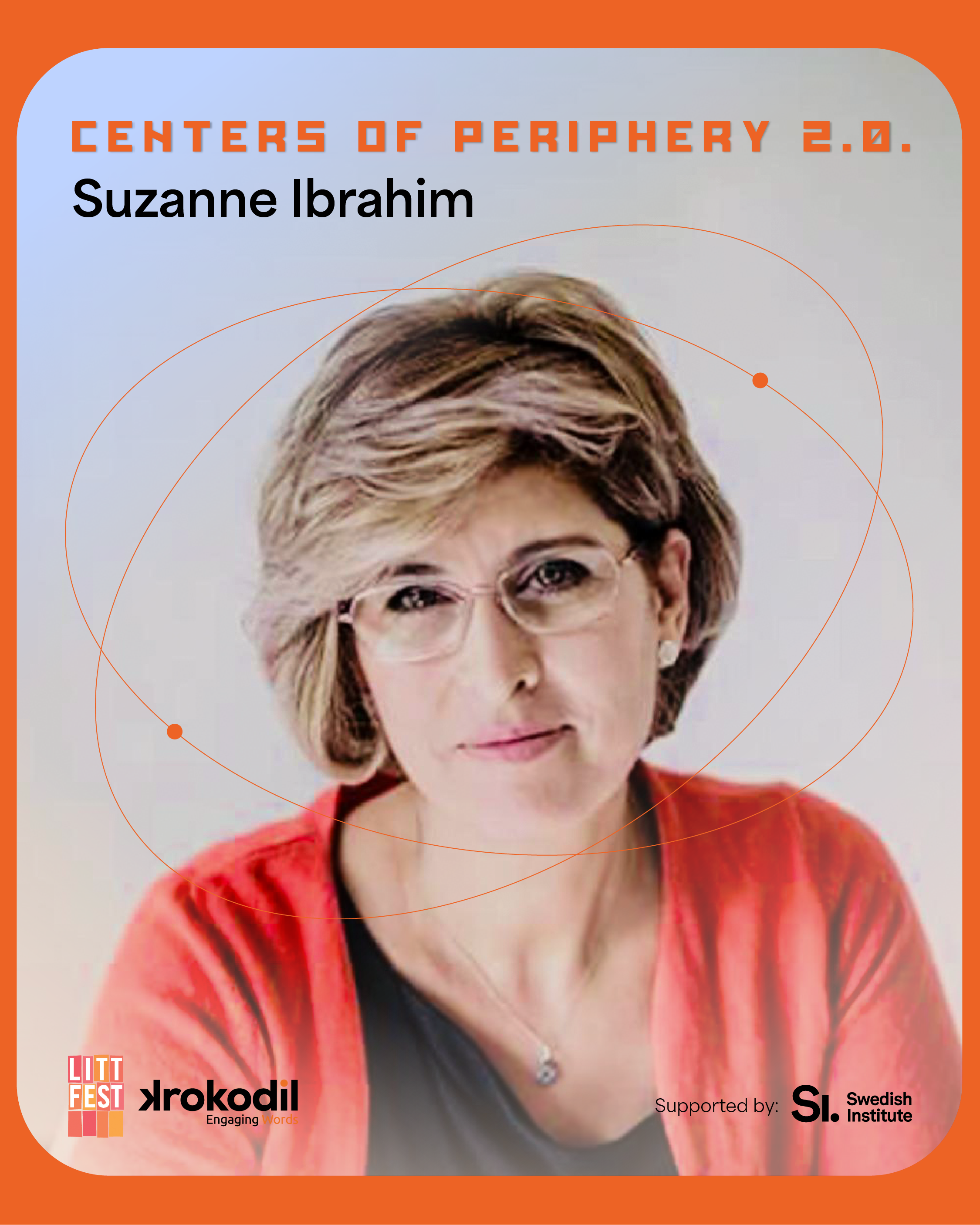
26 Nov Suzanne Ibrahim is the 151st guest of the KROKODIL residency for literary creators
Suzanne Ibrahim, a poet, prose writer, and journalist from Syria, who has been living and creating in Sweden for the past seven years, is the 151st guest of the KROKODIL residency for literary creators. She is staying in Belgrade during November and December, thanks to the project “Centers of Periphery 2.0.”
On Thursday, December 5th at 14:30, a translation workshop will be held at the KROKODIL Center (Male Stepenice 1a), where students of Arabic Studies from the Faculty of Philology, as well as other interested individuals who are familiar with the Arabic language, will have the opportunity to work on the translation of an excerpt from Suzanne’s work. The workshop will be led by Dragana Đorđević, an associate professor at the Faculty of Philology and a translator. Next week, on December 11th at 18:00, also at the KROKODIL Center, the audience will have the chance to get to know this author through a conversation led by Mirko Dautović, an analyst of international relations, who will talk with Suzanne about the circumstances which led to her leaving Syria, as well as the conditions of journalistic and literary work during the war in that country.
Suzanne Ibrahim, having lived in Damascus during the early years of the conflict, documented the impact of the war on everyday life and the cultural scene. Facing increasing restrictions, censorship, and risks, as the conflict escalated and freedom of expression diminished, she left Syria due to political pressures and threats to her life, in search of a space where her writing activities could continue without obstruction. She arrived in Sweden as a resident within the ICORN program (2018–2020), which provided her with protection and a platform for continuing her literary and cultural work in exile. She continues to live in Sweden, where she writes, publishes, and speaks about war, memory, displacement, and identity from a diaspora perspective.
Suzanne Ibrahim is a Syrian-Swedish poet, prose writer, and journalist, born in Homs, Syria. She earned a degree in English and obtained a diploma in pedagogy and psychology at Al-Baath University. For fourteen years, she worked as a cultural journalist in Damascus, writing for leading Syrian and Arab newspapers and editing sections on literature and culture. She has published several books in Arabic, including five poetry collections, three short story collections, and a novel titled “No Doves Above the City.” Her novel “When the Wind Explodes Against My Skin,” originally written in Arabic and published in Swedish translation in 2019, documents everyday life during the war in Syria.
In her works, Suzanne Ibrahim explores themes of human condition, freedom, exile, and the position of women in contemporary Syrian society. Her works have been translated into French, Swedish, Catalan, Persian, Spanish, and English. Between 2018 and 2020, she was an ICORN (International Cities of Refuge Network) writer-in-residence in Östersund, Sweden, and since then has participated in numerous literary residencies and international festivals across Europe.
Mirko Dautović is an analyst of international relations who holds a master’s degree in international studies from Cambridge and currently teaches international relations at Webster University in Tashkent. He often appears in the media, analyzing global crises and geopolitical processes.
Suzanne Ibrahim’s residency is part of the “Centers of Periphery 2.0” project created by the literary festival Littfest from the Swedish city of Umeå and the KROKODIL Association from Belgrade, with the aim of strengthening connections between the Nordic and post-Yugoslav cultural scenes as well as developing a strong foundation for cooperation; promoting democratic values, freedom of expression, and human rights through literary exchange; amplifying peripheral and/or underrepresented voices; and creating opportunities for dialogue. The project’s activities include two gatherings of literary professionals in Belgrade and Gothenburg in 2025 and a festival exchange between KROKODIL and Littfest in 2026, as well as six monthly residential stays for literary creators from Sweden in Belgrade, including public events and meetings with relevant literary and cultural actors. The project aims to encourage literary exchange between these two peripheral regions of Europe by providing platforms for discussion on key themes, such as democracy, human rights, and freedom of expression, as well as essential contemporary literary expressions of these fundamental values.
The “Centers of Periphery 2.0” project is supported by the Swedish Institute.
Sorry, the comment form is closed at this time.